If you ask three machinists to explain the difference between jigs and fixtures, you’ll likely get three different answers. It’s one of those things that gets mixed up constantly, especially by anyone who isn’t actually standing at the machine.
But when you’re planning a setup, that distinction becomes critical. How you hold a part changes everything: alignment, repeatability, and how quickly the next piece can be loaded. For a one-off prototype, it’s not a huge deal. But for a production run of a thousand parts? It’s everything.
The main difference between a jig and a fixture in machining lies in how they control the tool and hold the workpiece. A jig guides the cutting tool for accurate hole placement, while a fixture simply holds the part steady for CNC or automated operations. This table summarizes the key distinctions at a glance.
| Feature | Jig | Fixture |
| Main Job | Holds the part and guides the tool (think bushings). | Just locks the part in place while the machine moves. |
| Common Tasks | Drilling, reaming, tapping. | Milling, turning, grinding, and inspection. |
| Complexity | Usually higher (requires precision guide plates). | Can be simpler, but it must be extremely rigid. |
| Purpose | Accuracy for manual hole patterns. | Fast, repeatable loading for CNC work. |
Jigs and fixtures are designed to eliminate positioning variability. Operators should not manually position each workpiece. The setup itself should dictate exactly where the part sits and how the tool hits it. Once that's dialed in, the machine just repeats the process without you having to mess with it.
Many shops still build their own fixtures from scratch, although this approach is becoming less common. Most production work is moving toward specialized partners who already have the setups dialed in. Companies basically merge the CNC machining with the fixture design, so you can go straight from a CAD file to a finished part without burning three weeks just to build the tooling.
Before looking at applications, it helps to understand what jigs and fixtures actually are. So, what are jigs and fixtures?
A jig positions the workpiece and guides the cutting tool.
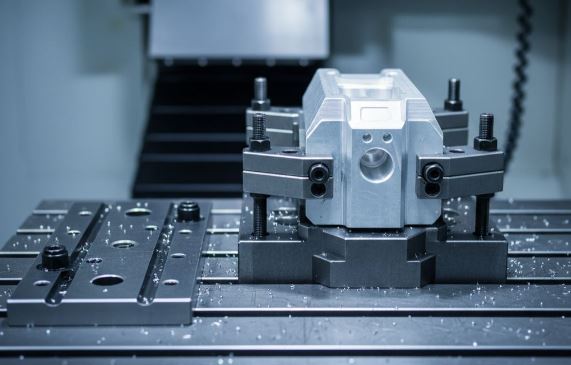
A fixture holds and locates the workpiece while the machine tool controls the cutting path.
That’s the core difference.
Jigs are commonly used for drilling operations where guide bushings control exactly where the drill enters the part. Fixtures are more common in CNC machining, where the program determines tool movement and the fixture simply keeps the part rigid and correctly positioned.
Most machining problems come down to consistency. You might be able to line up one part correctly by hand, but doing that the same way fifty or a hundred times is where things start to drift.
Jigs and fixtures eliminate that guesswork.
Once the CNC workholding setup is designed, the operator loads the part into a defined location and runs the operation. The setup itself ensures the position stays consistent.
You’ll see them used in operations like:
● drilling repeating hole patterns
● milling the same geometry across batches of parts
● tapping threaded features
● inspection setups where parts must sit in a controlled orientation
In production environments, this saves time, but more importantly, it keeps the process predictable.
By knowing the difference between jigs and fixtures, they make machining operations much easier to control.
Some of the practical advantages include:
● Consistent part location for better machining accuracy
● Reliable repeatability across production runs
● Faster loading and unloading during batch production
● Less manual alignment for the operator
● More stable cutting conditions during machining
● Used for accurate drilling, milling, inspection, and mass production workholding
They’re not the most exciting part of machining, but they quietly determine how smoothly a job actually runs.
In a perfect world, the choice is easy. In a real shop, you choose based on your machines and your volume. You shouldn't be asking "What’s the textbook definition?" You should be asking, "What makes this job run faster?"
Jigs are the go-to when hole accuracy and repetition are the priorities, especially on manual equipment.
If you’re drilling a hundred plates with the same hole pattern, you don't want an operator manually locating every single hit. A jig solves that by physically forcing the drill through a hardened bushing. Use them when:
● You're running large batches of identical hole patterns.
● Manual drill presses are your main bottleneck.
● You need to remove the operator "drift" from the equation.
Fixtures are the kings of the CNC world. Once you’ve programmed the CNC toolpath into a machining center, you don't need a physical guide. The machine already knows where it's going. You just need the part to stay put.
That’s where the fixture comes in. It's built for:
● Multi-axis milling, where heavy clamping is a must.
● High-speed cycles where you need to swap parts in seconds.
● Automated setups where the machine handles the "guidance" part.
The line between these two used to be thick. Today, it's a bit blurry.
You’ll see "hybrid" tools that locate a part like a fixture but still have a bushing plate for a specific manual operation. Plus, modern CNC systems have reduced the need for traditional drilling jigs in many machining operations. If the machine's positioning is spot-on, the "guidance" part of a jig is already built into the software.
Tags :
 SUBSCRIBE TO OUR NEWSLETTER
WHATSAPP : +86-15375471059
EMAIL : allan@safekeso.com
PHONE NUMBER : +86 15375471059